
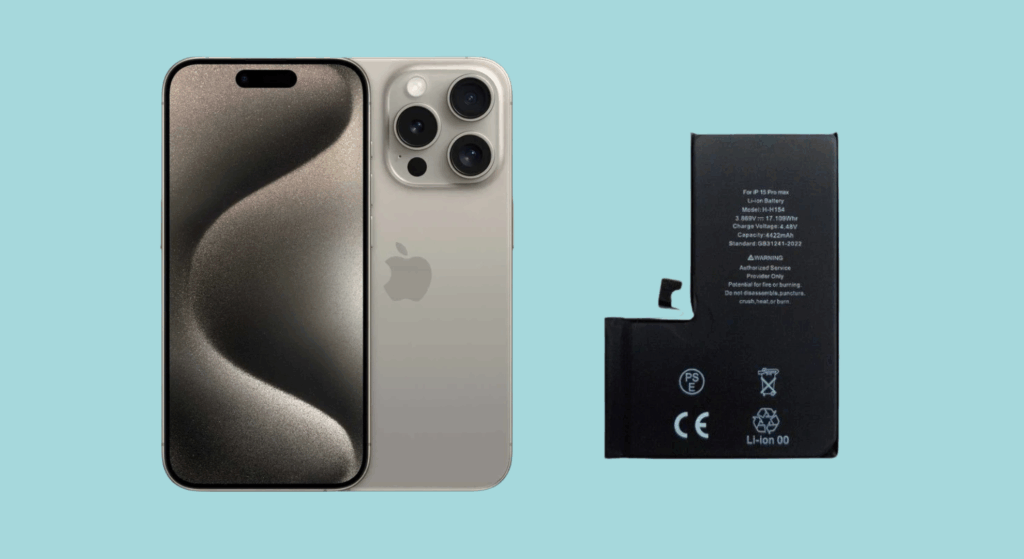
Understanding iPhone battery size is essential whether you’re comparing iPhone models, checking battery life, or stocking replacement parts. While mAh battery capacity matters, real performance depends on Apple’s new chips, power efficiency, screen brightness, background activity, and how a lithium battery chemically ages.
From popular devices like the iPhone 11 Pro Max, iPhone 13 Pro Max, iPhone 14 Pro Max, and iPhone 15 Pro Max, each model delivers different battery performance.
This guide provides an accurate, comprehensive list of iPhone battery mAh ratings, plus practical tips to extend battery life. Ideal for repair shops, wholesalers, and users who want clear, reliable data.
Overview: Why iPhone Battery Size Matters?
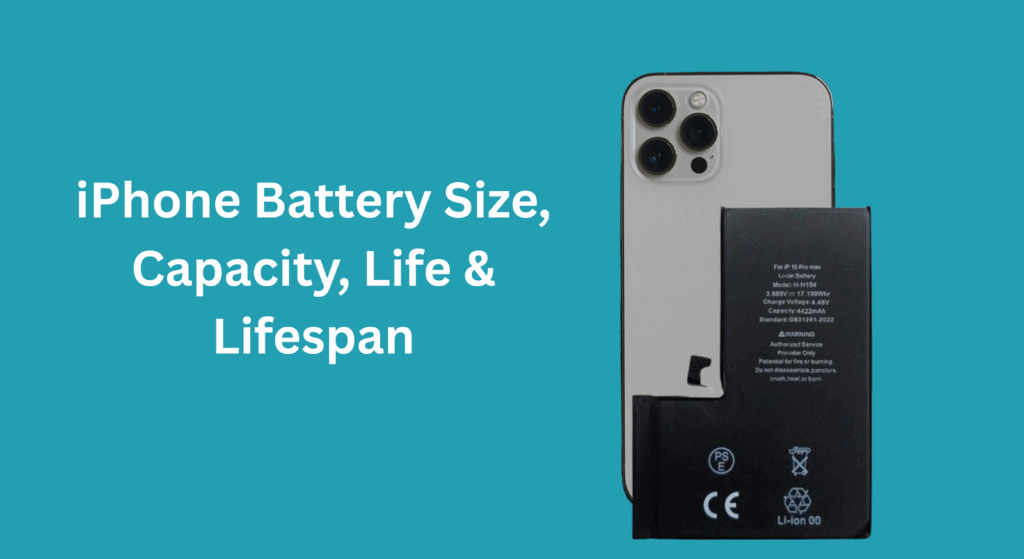
Understanding iPhone battery size (mAh) is essential for evaluating true battery life, planning replacements, and advising customers. Battery capacity represents how much energy a device can store, but it doesn’t tell the whole story.
Real-world battery performance also depends on Apple’s new chips, software optimization, background activity, screen brightness, camera usage, and how a lithium battery chemically ages over time.
For repair shops, wholesalers, and B2B partners, accurate iPhone battery capacity data is critical. It ensures proper inventory planning, helps match the right iPhone models, and supports customers who need reliable guidance on when to replace a battery or upgrade devices.
Whether dealing with an iPhone 11 Pro Max, iPhone XS Max, or newer models like the iPhone 16 Pro Max, correct mAh details lead to better service, fewer returns, and higher customer satisfaction.
iPhone Battery Size (mAh) List by Model
While Apple highlights “battery life” instead of raw capacity, technicians and B2B buyers rely on accurate mAh data to manage inventory, improve diagnostics, and recommend the right upgrades. The exact battery capacity in mAh can be found in several authentic sources, which help us compare different models.
iPhone 15 / 14 / 13 Series Battery Capacity
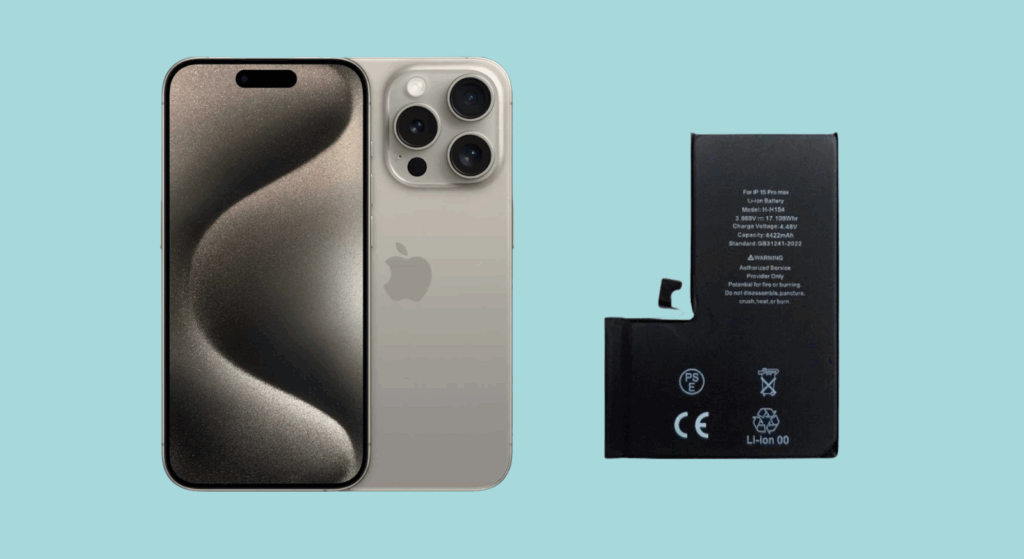
These series feature significant improvements in battery efficiency thanks to newer chips (A15, A16, A17 Pro), energy-efficient OLED displays, and iOS optimizations such as Low Power Mode and background activity management.
These models are popular in repair markets because users often keep them for years, making battery replacement a high-demand service. Here’s the table with reported battery capacities for these models:
| Model | Reported Battery Capacity (mAh)* |
| iPhone 15 Pro Max | 4422 mAh |
| iPhone 15 Pro | 3274 mAh |
| iPhone 15 Plus | 4383 mAh |
| iPhone 15 | 3349 mAh |
| iPhone 14 Pro Max | 4323 mAh |
| iPhone 14 Pro | 3200 mAh |
| iPhone 14 Plus | 4325 mAh |
| iPhone 14 | 3279 mAh |
| iPhone 13 Pro Max | 4352 mAh |
| iPhone 13 Pro | 3095 mAh |
| iPhone 13 | 3227 mAh |
| iPhone 13 mini | 2406 mAh |
iPhone 12 / 11 / XS / XR / X Battery Capacity
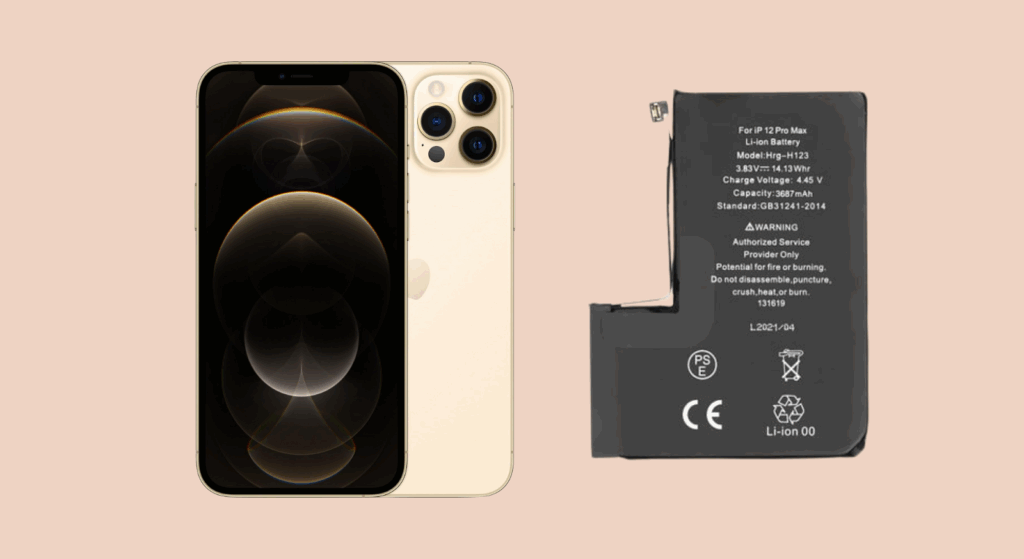
This generation is critical to the repair industry because millions of these devices remain active worldwide. Many users experience battery degradation after 2–4 years, making these models top sellers for replacement batteries.
Despite having smaller capacities than newer models, the A13/A12/A11 chips still offer stable performance when paired with a fresh, high-quality battery. Here’s the table with reported battery capacities for these models:
| Model | Reported Battery Capacity (mAh)* |
| iPhone 12 Pro Max | 3687 mAh |
| iPhone 12 / 12 Pro | 2815 mAh |
| iPhone 12 mini | 2227 mAh |
| iPhone 11 Pro Max | 3969 mAh |
| iPhone 11 Pro | 3046 mAh |
| iPhone 11 | 3110 mAh |
| iPhone XS Max | 3174 mAh |
| iPhone XS | 2658 mAh |
| iPhone XR | 2942 mAh |
| iPhone X | 2716 mAh |
iPhone SE and Older Models Battery Capacity
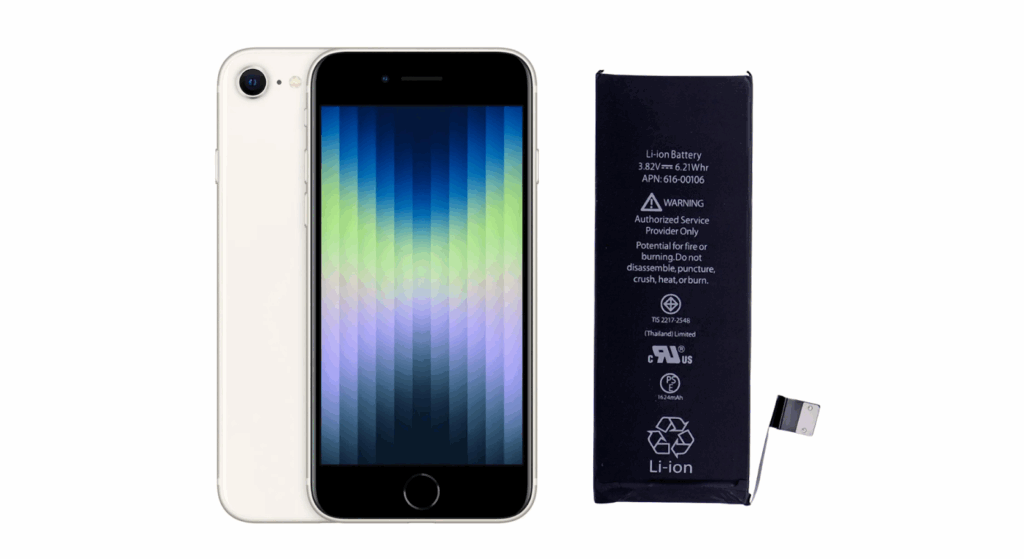
Older and SE-series iPhones use physically smaller lithium batteries, resulting in lower mAh capacity. These devices age faster due to compact battery design, older chips, and limited optimization features compared to modern models.
Repair shops commonly replace these batteries to extend device lifespan and keep budget-friendly models functioning reliably. Here’s the table with reported battery capacities for these models:
| Model | Reported Battery Capacity (mAh)* |
| iPhone SE (2022 / 3rd gen) | 2018 mAh |
| iPhone SE (2020 / 2nd gen) / iPhone 8 | 1821 mAh |
| iPhone 8 Plus / iPhone 7 Plus / 7 / 6s / older (select) | Varies. |
Which iPhone has the Largest Battery? (Quick Summary)
Not all iPhones with the highest mAh deliver the longest battery life, but capacity still plays a major role. The Pro Max lineup consistently leads due to physically larger frames and efficient OLED displays. Newer models with A17 and A16 chips also squeeze more screen-on time out of every mAh thanks to improved power management, background app control, and lower idle drain.
The iPhone 15 Pro Max currently holds the largest battery among all iPhone models. Still, real-world endurance is also shaped by Apple’s chip efficiency (A17 Pro), adaptive brightness, optimized battery charging, and OLED panel power savings.
On the other hand, older models like the iPhone 11 Pro Max and iPhone XR remain surprisingly strong thanks to balanced hardware and lower software requirements.
iPhone Battery Life Comparison (Real-World Performance)
Things change when we compare battery life and capacities across different models in real-world use. Let’s break it down:
Why Battery Size ≠ Battery Life?
At first glance, a higher iPhone battery size (mAh) might seem like a direct indicator of longer battery life. However, a large battery alone doesn’t guarantee long-lasting performance. Efficiency depends heavily on the interplay between battery capacity, chipset energy consumption, display technology, software behavior, and user habits.
In many smartphones, whether iPhone or Android, a well-optimized device with moderate capacity can outlast a poorly optimized one with larger capacity. That’s why repair shops, wholesalers, and end users must treat mAh as a single metric, not the whole story.
Chip Efficiency: A-series Chips and Battery Performance
Modern iPhones use highly efficient Apple-designed chips (e.g., A15, A16, A17), which significantly affect real-world battery performance. These processors manage tasks intelligently, switching between high-performance and “efficiency” cores as demand changes, reducing energy waste during standby or light use while powering smoothly under load.
When chips work in harmony with iOS optimization, even a modest-capacity battery can deliver solid battery life. On the other hand, device aging or heavy background processes (apps, 5G, frequent camera use) will drain even a high-capacity battery faster.
In short, part of what you “pay for” with a new battery or newer model is not only more battery power, but also reduced energy draw per task, a key differentiator for wholesalers evaluating demand across older vs newer iPhone models.
OLED vs LCD: Display Tech and Power Consumption
Display technology matters as much as battery capacity. iPhones with OLED or Super Retina XDR panels tend to manage power more efficiently, especially when using dark mode, adaptive refresh (on Pro models), or automatic brightness. OLED panels can entirely shut off pixels for true blacks, reducing energy consumption compared to older LCD screens that keep the backlight on full for bright images.
For example, newer OLED-equipped iPhones (with high mAh batteries) deliver better real-world battery life per charge than older LCD models with similar capacity, making replacement parts and battery sourcing decisions more nuanced than “just pick the largest mAh.”
5G vs 4G / Network & Usage Impact
Network connectivity (5G vs 4G/LTE) also affects battery life. 5G radios consume more power, especially when the signal is weak or switching between bands frequently. For repair shops and wholesalers, that means devices sold or repaired in areas with unstable 5G may see shorter practical battery life than capacity suggests.
Usage patterns, streaming video, GPS, and constant background activity further amplify these effects. So a device with 4,500 mAh might last less than one with 3,800 mAh under heavy 5G, camera, display, and data usage.
Ranking: Top 5 Longest-Lasting iPhones (Real-World Use)
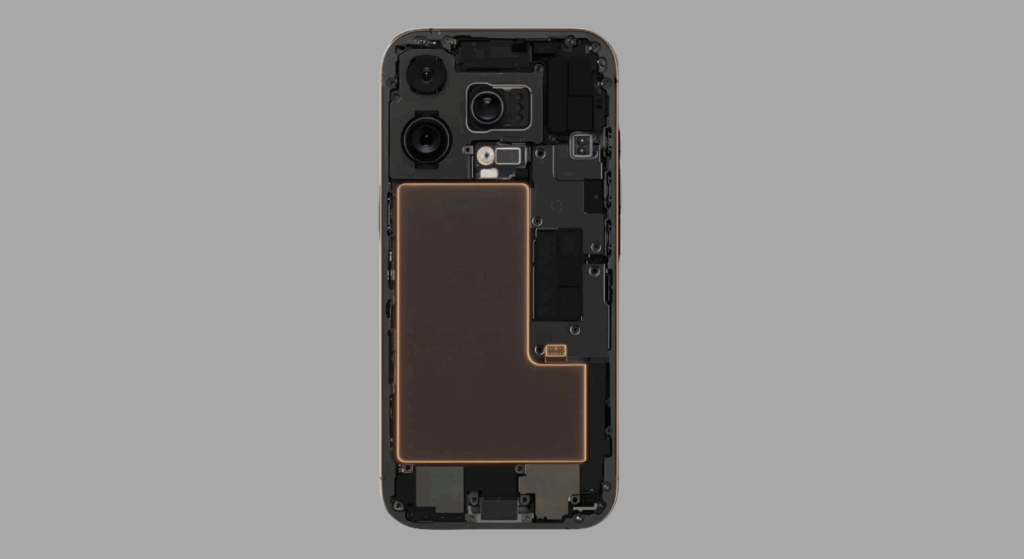
Based on battery capacity, chipset efficiency, and reports from independent testing, the iPhones below tend to deliver among the best all-day battery life in 2025 (for typical to heavy use):
- iPhone 17 Pro Max: Expected to lead the lineup with one of the largest battery capacities and next-gen chip efficiency, delivering exceptional all-day power even under heavy use.
- iPhone 16 Pro Max: Features a bigger battery than the 15 Pro Max, paired with improved A18 chip efficiency, making it one of the strongest performers in real-world usage.
- iPhone 15 Pro Max: Large battery + efficient OLED + optimized chip → strong all-day performance.
- iPhone 15 Plus / 14 Plus: Balanced large battery and efficient power use, ideal for users who prioritize standby and screen-on time.
- iPhone 13 Pro Max: Still competitive, especially after a battery replacement, thanks to its solid capacity and A15 chip efficiency.
What does this mean for Repair Shops & Wholesalers?
Repair shops and wholesalers should:
- Stock Smart, not Just Big: Don’t assume the highest-mAh batteries will always satisfy buyers.
- Advise Customers Realistically: When recommending a replacement or selling a refurbished phone, explain the interplay between capacity, chip efficiency, display, and usage patterns.
- Quality Matters. Cheap batteries with correct mAh but poor discharge curves or rapid degradation will underperform, creating after-sales issues and harming reputation.
- Check Real-World Performance After Replacement: Always test with video playback, screen-on time, and light user tasks under realistic conditions, not just synthetic benchmarks.
Battery Size vs Battery Lifespan: What’s the Difference?
Battery capacity determines how much power a device can store, while lifespan reflects how long that battery can maintain usable performance as it chemically ages.
mAh Capacity (Battery Size)
The mAh capacity represents the total amount of battery power an iPhone can hold. Larger mAh values usually indicate longer battery life, but factors such as new chips, software optimization, and screen technology also influence real-world performance.
- Higher mAh = larger battery size
- Influences standby time, usage hours, and background activity
- Affects power demands for features like 5G, camera, and high-brightness displays
- Not the only indicator of battery performance
- Newer models like the iPhone 17 Pro Max and iPhone 16 Pro Max use high-density lithium batteries for better energy efficiency.
Battery Cycle Count
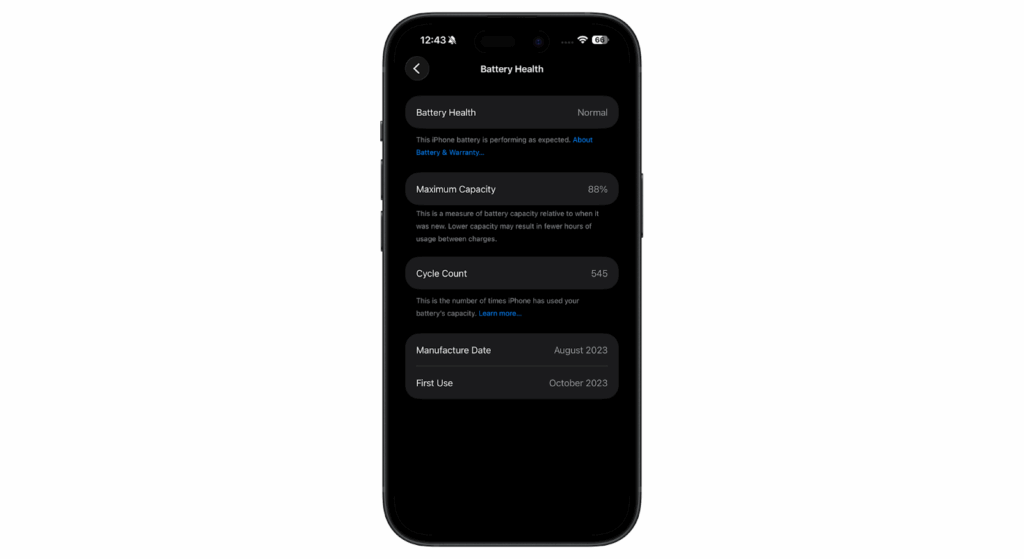
Before batteries need replacement, they go through hundreds of charge cycles. Apple lithium batteries are engineered to retain about 80% of their capacity after 500 or even 1000 cycles under regular use.
- One charge cycle = using 100% of the battery, not necessarily in one session.
- High cycle count = lower battery health
- Intensive apps, gaming, and heat accelerate cycle consumption
- Shops should always check Settings > Battery > Battery Health & Charging before advising customers. Only available in some latest models.
Cycle count is one of the most significant factors in how quickly an iPhone battery chemically ages and loses performance.
Degradation Timeline
Even without high cycle counts, iPhone batteries naturally degrade over time due to chemical aging. This impacts both peak performance and usable capacity. Typical degradation factors include:
- High temperatures (hot environments, gaming, constant 5G use)
- Frequent fast charging or overnight charging
- Non-certified chargers or poor-quality replacement batteries
- High screen brightness and heavy background app refresh
- Using the phone while charging
Degradation reduces performance, increases background activity drain, and requires more frequent charging.
Typical Lifespan of an iPhone Battery (in Years)
With normal usage, an iPhone battery typically lasts:
- 2–3 years before noticeable decline
- 3–4 years before major performance issues
- 4+ years only if the device is lightly used and well-maintained
Models like the iPhone 11 Pro Max, iPhone 13 Pro Max, and iPhone 14 Pro Max maintain healthy batteries longer due to efficient chips and optimized battery charging features. Repair shops often see customers return around the 80% battery health mark, a strong indicator that replacement is needed.
Signs a Battery Needs Replacement
Repair customers usually notice performance issues before battery health drops below Apple’s recommended threshold. Shops and wholesalers should help users identify early symptoms. Common signs are:
- Rapid battery drain even on light usage
- Sudden shutdowns or performance throttling
- Slower app loading and background refresh delays
- Device heating during everyday tasks
- Screen dimming or forced Low Power Mode
- Battery health is dropping below 80%
- Charging is taking longer than usual
- iPhone showing “Service” battery warning
- Swollen battery.
For repair stores, offering quality OEM-grade batteries ensures better longevity, fewer returns, and improved customer satisfaction.
How to Improve iPhone Battery Lifespan (Professional Tips)?
Extending iPhone battery lifespan is critical for both everyday users and repair shops that want to reduce warranty issues, returns, and customer complaints. These simple practices help slow the chemical aging of lithium batteries, improve battery performance, and maintain healthier capacity over time.
- Optimize Charging Habits
Charging habits directly affect long-term battery health. Avoid charging to 100% or letting it drop to 0%, and try to keep daily use between 20–80%. Also, avoid heavy use, like gaming or camera recording, while charging, as this reduces heat and helps maintain stable battery power.
- Enable Optimized Battery Charging
Apple’s Optimized Battery Charging slows chemical aging by learning your routine and preventing the battery from staying at 100% overnight. For this:
- Go to Settings → Battery → Charging.
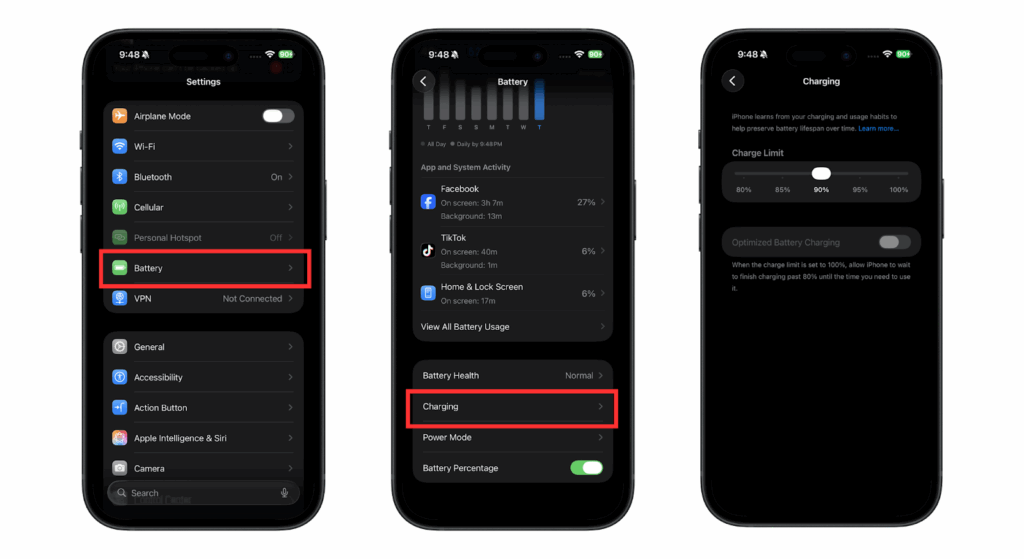
This is essential for newer models, such as the iPhone 17 Pro Max and iPhone 15 Pro Max.
- Reduce Screen Brightness & Use Auto-Brightness
Your display is one of the biggest power drains on any iPhone. Keeping brightness lower and using Auto-Brightness helps conserve energy. At the same time, features like Always-On Display on Pro models can be turned off to further extend battery life without affecting usability.
- Avoid Extreme Temperatures
Heat is the biggest enemy of lithium batteries. Keep the device away from hot environments, and avoid heavy tasks like gaming or long video recording while charging. This prevents overheating, slows degradation, and protects long-term battery performance.
- Check Battery-Draining Apps
Some apps cause heavy background activity and drain power quickly. For this:
- Go to Settings → Battery to see usage and background app refresh.
- Disable Background App Refresh for unnecessary apps. You can do this by going to “Background App Refresh” in Settings.
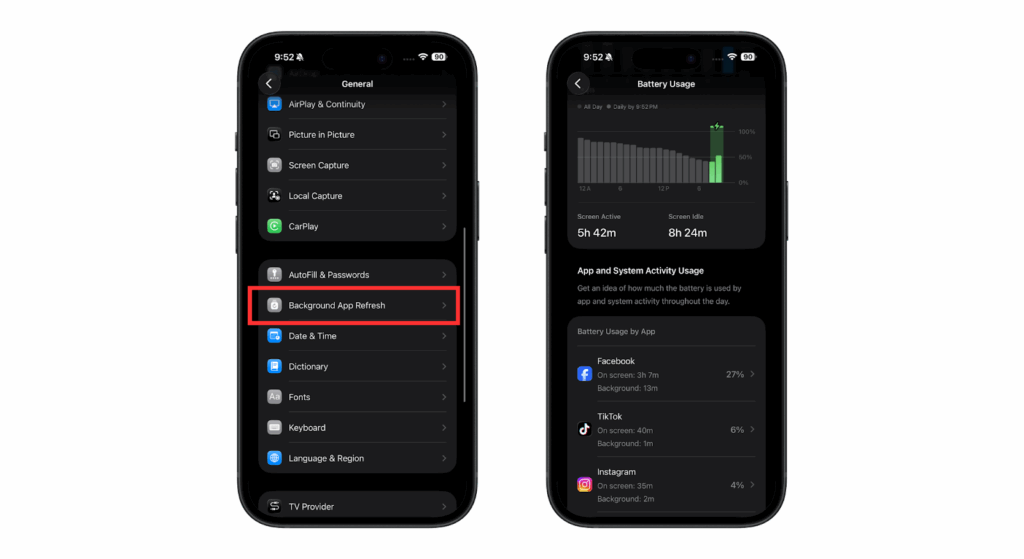
This improves daily battery life and reduces stress on capacity.
- Use Certified Batteries (Important for Repair Shops)
For repair stores, using OEM-quality or high-grade aftermarket batteries is essential. Poor-quality parts degrade faster, and incorrect capacity readings cause customer complaints.
Certified batteries ensure accurate mAh capacity, better performance, and safer long-term use, especially for high-demand models like iPhone 11 Pro Max, iPhone 13 Pro Max, and iPhone SE.
iPhone Battery Replacement Guide
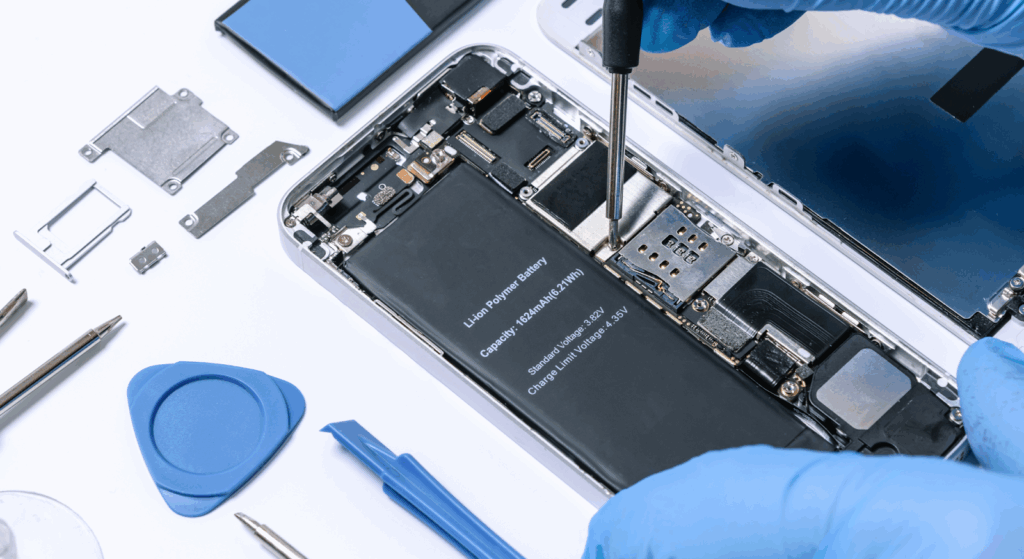
A reliable iPhone battery replacement process depends on stocking accurate mAh options and high-quality parts. Repair shops and wholesalers can reduce returns, improve customer satisfaction, and maintain consistent battery performance by choosing the right components.
Original vs Aftermarket Batteries
OEM batteries offer the most accurate capacity, best battery health reporting, and stable performance across all iPhone models. High-quality aftermarket options can also work well, but only if they follow strict standards and match the original mAh specifications.
Common Issues With Low-Quality Replacement Batteries
Cheap replacements often trigger battery health errors, drain faster, heat up, or fail prematurely. These issues are common when using batteries with inaccurate battery capacity ratings or poor lithium cell construction.
Why Wholesalers Should Maintain Full mAh Inventory
Keeping every battery size, from iPhone SE to iPhone 15 Pro Max, ensures repair stores never lose customers due to stock shortages. A complete inventory also supports upsells, accurate replacements, and faster turnaround times.
Battery Health Warnings After Replacement: What Customers Ask?
After installing a new battery, users may ask why their battery health doesn’t show 100%, why they see a “Service” message, or how long the new battery will last. Shops should explain that batteries chemically age, calibration may take a few charge cycles, and only true OEM modules support full system accuracy.
Trends in iPhone Battery Technology
Apple continues to refine battery technology, combining more innovative software with higher-density lithium batteries to deliver better performance without drastically increasing size. For wholesalers and repair professionals, staying up to date on these trends ensures accurate inventory management and long-term planning.
Apple’s Move Toward Higher-Density Cells
Newer models, especially the iPhone 14 Pro Max and iPhone 15 Pro Max, use denser cells that deliver more battery life in nearly the same physical footprint. This shift improves energy efficiency while maintaining slim device designs.
Efficiency Gains With A-Series Chips
Apple’s A19, A17, and A16 chips reduce background activity, lower heat output, and stretch battery capacity farther than older chipsets. This makes mAh a less direct indicator of performance and improves real-world usage.
Predictions for Future Battery Size Increases
With the transition to USB-C, new chips, and more demanding features, Apple is likely to continue increasing mAh capacity, especially in larger models like the upcoming iPhone 16 Pro Max.
Impact on Aftermarket Parts Demand
Higher-density cells increase demand for verified, high-quality replacements. Repair shops and wholesalers that stock batteries with accurate capacity will lead the market as older models degrade and newer devices require certified replacements.
Frequently Asked Questions
Which iPhone has the biggest battery?
The iPhone 17 Pro Max has the biggest battery among all iPhone models. The iPhone 17 Pro Max battery capacity is approximately 4823 mAh for the version with a physical SIM and 5088 mAh for the eSIM-only version.
Why does my iPhone battery degrade quickly?
High temperatures, heavy background app refresh, long screen-on time, and frequent 0–100% charging cycles accelerate chemical aging of the battery.
How many years does an iPhone battery last?
Most lithium batteries last 2–3 years before noticeable decline. Heavy users or older models may see faster degradation.
Does a bigger battery mean longer life?
Not always. Chip efficiency, display type (OLED vs LCD), and software optimization often have a bigger impact than raw mAh numbers.
Is it worth replacing an old iPhone battery?
Yes. A new battery can restore performance, eliminate shutdowns, and significantly improve battery life, often extending a device’s usability by 1–2 years.
Conclusion
iPhone battery sizes vary across generations, but real performance depends on a balance of mAh, chip efficiency, software controls, and battery health management. Repair shops and wholesalers rely on accurate data to ensure proper replacements, minimize returns, and maintain customer trust.
Super Quest supplies high-quality iPhone batteries and parts for repair shops and wholesalers, ensuring accurate capacity, premium quality, and reliable performance across all iPhone models. Order now or contact us to get a quote.