
Looking to upgrade replacement displays for your repair shop or sourcing displays for wholesale? It’s important to know the difference between TFT vs IPS screen technology.
More than 1.2 billion smartphones shipped worldwide each year, resulting in millions of display screen replacements. Therefore, display quality should be a major consideration for wholesalers and repair shops.
Many business owners and technicians consider these as two different technologies, but they’re not. In reality, IPS is actually a form of TFT display technology that is based on the same technology, but with improvements in performance.
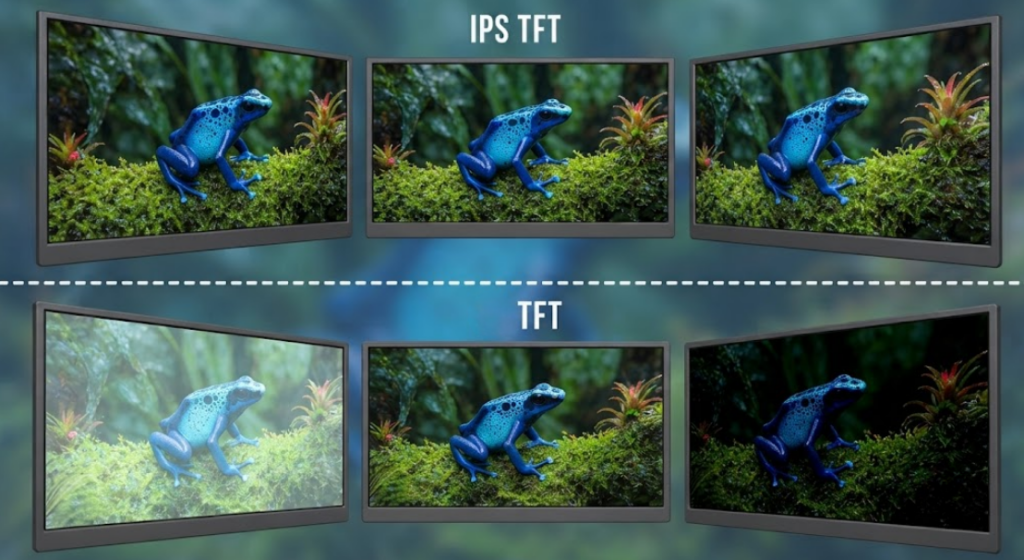
TFT vs IPS screen
This comprehensive guide breaks down the concept, working, and the difference between TFT and IPS displays. You will also gain insight into perks, applications, and considerations. Let’s get started!
What is TFT display technology?
TFT stands for Thin Film Transistor, the most important technology for active-matrix display screens. One of the key technologies of TFT displays is that each pixel is controlled by a separate transistor. It ultimately helps speed up response times and guarantees performance in several electronic devices.

TFT display technology
How do TFT LCDs work?
Before understanding the TFT LCD technology, it is important to understand its structure
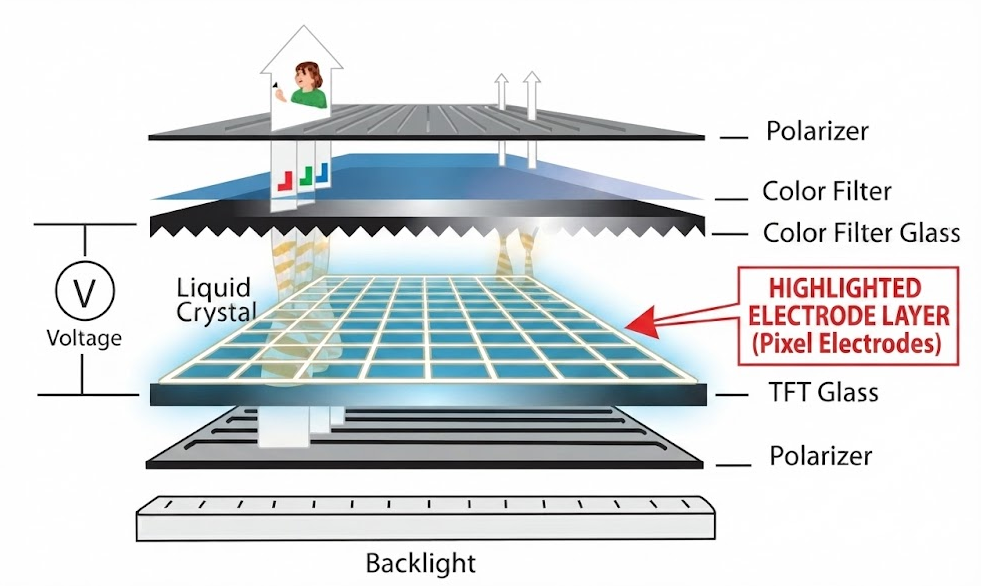
TFT LCD screens have a sophisticated structure that regulates light at the pixel level. Before learning how this structure works, it is important to know the components that make up this structure:
- Liquid crystal layer: Consists of crystal molecules that are capable of aligning in various directions upon electric field application.
- TFT (Thin Film Transistor): Acts as electrical switches and controls the applied voltage to liquid crystals.
- Pixel Electrodes: Apply electric fields directly to liquid crystals.
- Color Filter: Controls the colors of each pixel and comprises of red, blue, and green filters.
- Backlight: It acts as a light source that illuminates liquid crystals.
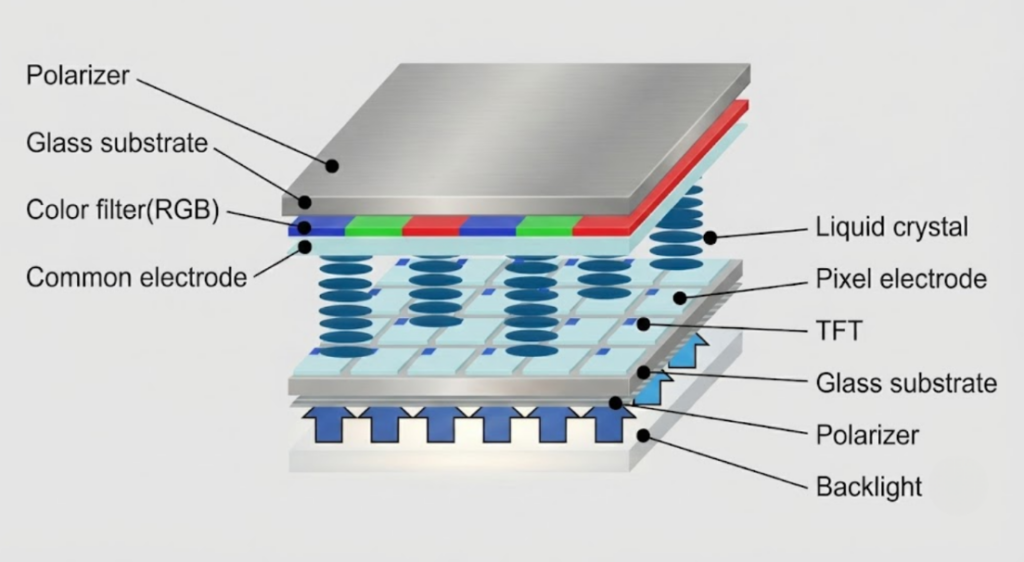
Components of TFT LCD display
Every pixel has an TFT, which acts as an electrical switch. The transistors regulate the amount of voltage that is delivered to each red, green, or blue sub-pixel. This voltage controls the direction of the liquid crystals, which are present between two polarized glass layers. Finally, this orientation of liquid crystals regulates the backlight passing through. Lastly, the color filters generate the desired colors on the screen. Thus, the millions of pixels come together to create clear, sharp, and bright images on screen.
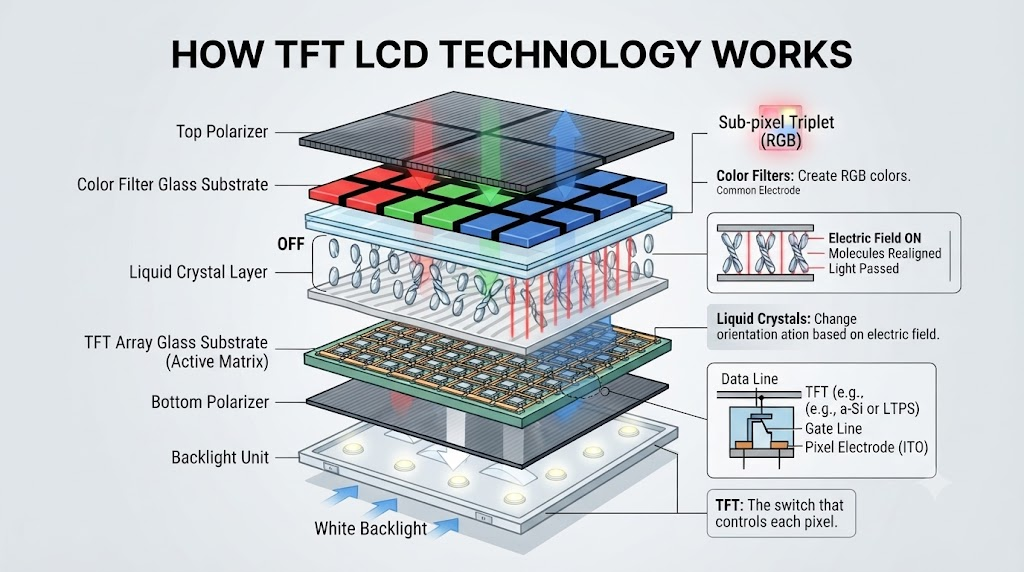
How TFT LCD technology works
Why is TFT still everywhere?
Fast Response Times: TFT displays respond in 1-5 milliseconds to the change in voltage, which is great for interactive applications. This way, customers can experience immediate visual feedback upon interaction with your point-of-sale system.
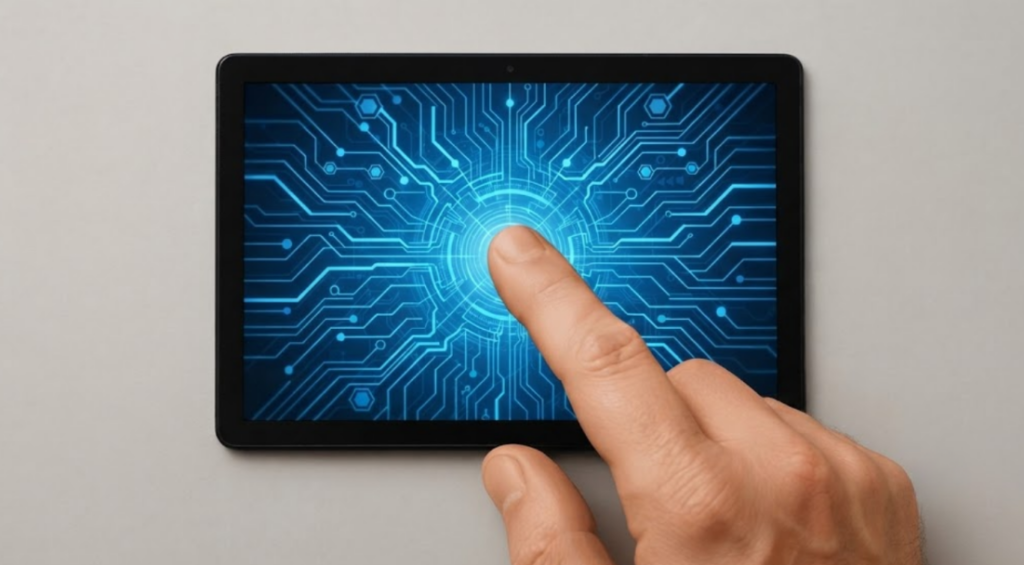
Fast response time
Lower Production Costs: The production of TFT LCD is mature and efficient. There are existing supply chains that help to reduce material costs and make the process easier. This is good news for mobile phone screen repair stores that buy replacement LCDs in bulk.
Broad Device Compatibility: TFT technology is used in a variety of devices, including smartphones, tablets, industrial touch panels, medical devices, and consumer electronics. Its proven dependability means fewer customer returns and warranty issues.
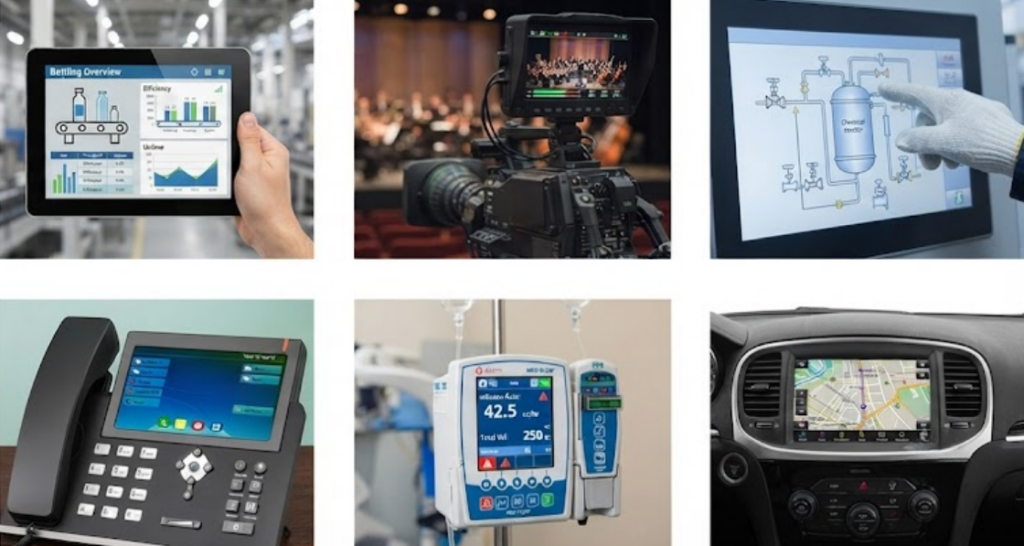
broad device compatibility of TFT display
Please note that IPS is not an alternative to TFT, which most articles oversimplify. It is actually an improvement to the TFT-LCD technology, in which the liquid crystal molecules align better.
What is IPS display technology?
IPS is an acronym for In-Plane Switching, an improvement of the TFT technology which eliminates the viewing angle problem. IPS display is not a new fabrication method for thin-film transistors, but is an evolution that alters liquid crystal arrangement and control.

IPS display technology
All the components of an IPS display are the same as those of TFT display technology. The only difference is in TFT display uses electrodes on top and bottom. While on an IPS display, the electrode layers are present on the same lower glass substrate.
Structure of the IPS display technology
How does IPS improve on TFT?
Normally, in standard TFT LCDs, the liquid crystal molecules bend in the vertical direction upon voltage application. This vertical alignment gives rise to a fundamental issue. The light transmission is not uniform at larger viewing angles, with a resultant color shift and loss of brightness.
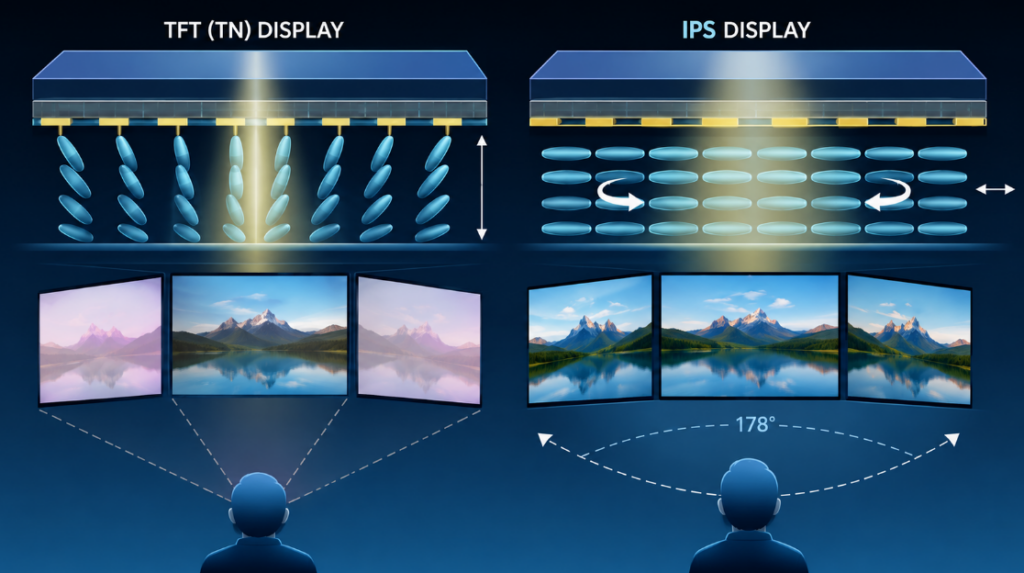
Difference between TFT and IPS display
IPS technology overcame this by causing the liquid crystals to rotate horizontally (parallel to the surface of the display). They do not tilt up and down, but rather swing from side to side in the same plane. This horizontal motion lets more light through – irrespective of viewing angles. As a result, you can experience uniform color and brightness in a 178-degree viewing angle in all directions.
Key IPS display advantages
Wide Viewing Angles: IPS panels have the ability to keep the picture quality even from extreme viewing angles. This is an important factor for phone repair shops when customers are looking at their phones before they leave your shop. OR when multiple people need to look at the same screen at the same time.
Better Color Accuracy: Horizontal liquid crystal arrangement offers improved color uniformity. Reds remain red, blues remain blue regardless of position. For smartphones intended for photography or content creation, color accuracy is particularly critical in ensuring user satisfaction.
Consistent Brightness: Unlike traditional TFT screens that dim when looked at from an angle, IPS screens have uniform brightness throughout the viewing area. This uniformity makes IPS displays perfect for outdoor applications where the sun can shine on the screen from different angles.
Improved Image Quality: The combination of better color reproduction and consistent brightness creates a noticeably superior visual experience. High-end smartphones and professional displays almost exclusively use IPS technology.
Difference between TFT and IPS: Key facts revealed
To help you make the right TFT vs IPS Screen sourcing decision, here’s a detailed comparison:
| Feature | Standard TFT LCD | IPS LCD |
| Viewing Angles | Moderate (typically 160°) | Excellent (typically 178°+) |
| Color Accuracy | Good, but inconsistent off-center | Excellent, consistent across angles |
| Brightness Consistency | Moderate, fades at wide angles | High, remains uniform |
| Contrast Ratio | Moderate (around 600:1-1000:1) | Better (around 1000:1-1500:1) |
| Response Time | Fast (1-5 milliseconds) | Fast (4-8 milliseconds, often 5ms typical) |
| Manufacturing Cost | Lower | Higher |
| Typical Applications | Entry-level phones, industrial equipment | Mid-range & flagship smartphones, professional displays |
| Power Efficiency | Higher (slightly lower backlight demand) | Moderate (requires higher backlight intensity) |
TFT vs IPS screens for Smartphones
This distinction is clearly evident in the smartphone market. Knowing the positioning of the devices can assist repair shops in keeping the appropriate replacement LCDs on hand.
Entry-level smartphones: To reduce costs, entry-level smartphones may utilize a standard TFT display. These are devices that attract the attention of consumers who don’t care much about display quality. Rather, they only want to make a fair purchase. But customers who use these phones for social media or simply surfing the web don’t usually care about viewing angle restrictions.
Mid-range and flagship smartphones: Years ago, every mid-range and flagship smartphone shifted to IPS technology. Why? Users who spend $400+ are looking for a better display. IPS’ broad viewing angles and accurate colours are all useful for photography apps, video streaming, and gaming. Customers who have cracked mid-range screens on their phones are expecting that they’re going to get an IPS replacement with the same performance.
Outdoor Visibility: Neither standard TFT nor IPS displays naturally excel outdoors in direct sunlight. But the brightness consistency of IPS makes it better for those who use their phones outdoors a lot.
Touch Performance: Both technologies work harmoniously with the capacitive touchscreen layers. The technology used for the display has very little to do with touch responsiveness.
Display Durability: IPS panels are a little more durable for long-term use since the horizontal alignment of liquid crystals reduces the stress from thermal cycling. IPS displays offer refurbishment companies better aging characteristics.
TFT LCD vs IPS LCD – Which display is better?
The answer depends entirely on the use case and context.
IPS is ideal for:
- Smartphones that are used to take photos, make videos, or create content.
- Multi-user viewing from different angles, and situations.
- Professional or high-end consumer devices.
- Outdoor or semi-outdoor applications in which the viewing angle is important.
- Use of devices for extended periods of time in which consistent colour reproduction is important.
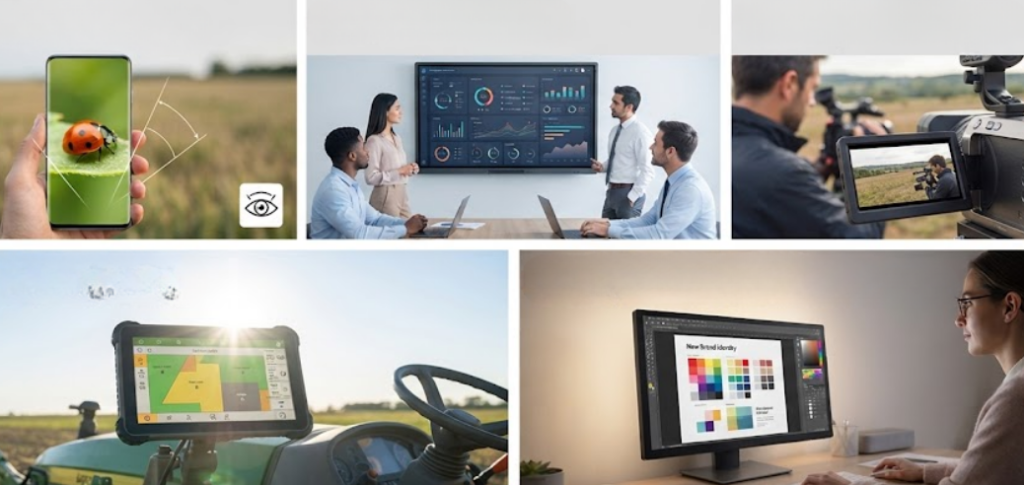
Applications of IPS display
Standard TFT is suitable for:
- Budget devices where cost matters more than display quality.
- Industrial equipment with fixed, head-on viewing positions.
- Applications that require a low response time and low power consumption.
- Entry-level electronics with predictable usage patterns.
- Large-scale deployments with cost considerations.

Applications of the TFT display
In particular, for cell repair outlets: If the client asks you for the replacement LCD, inquire about cell phone usage. IPS is an excellent technology for photography fans and those who work outdoors. Quality TFT choices allow budget users to run basic applications without any problems.
TFT vs IPS LCD technology for Phone Repair Shops
One of the most important issues that most competitors fail to take into consideration is your day-to-day sourcing decisions.
Choosing Replacement LCDs
The choices you make about your inventory have a direct impact on customer satisfaction and warranty claims. If you need to replace LCDs, take into account:
OEM vs Aftermarket Displays: Original manufacturer displays ensure exact colour matching and brightness uniformity. Not all aftermarket displays are equal in quality. IPS aftermarket screens vary more in quality than TFT screens. This is because technology is more prone to manufacturing defects with liquid crystal alignment.
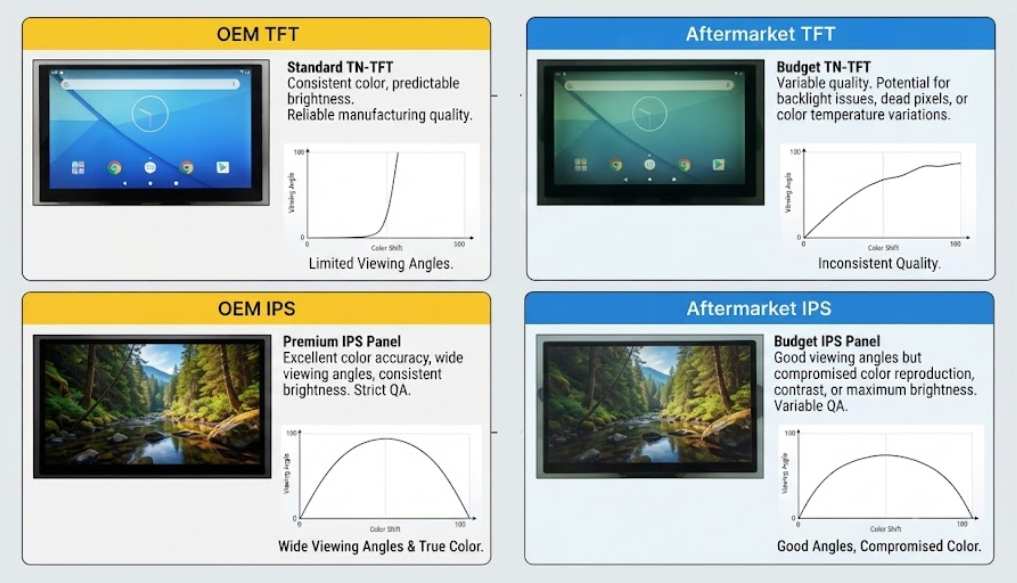
OEM vs aftermarket display comparisons
Color Consistency: Does the color of the replacement screen match the color of adjacent bezels and/or protective glass? IPS displays need to have accurate colors, or else customers notice. This is the reason why top repair shops charge extra for genuine IPS panels because of noticeability.
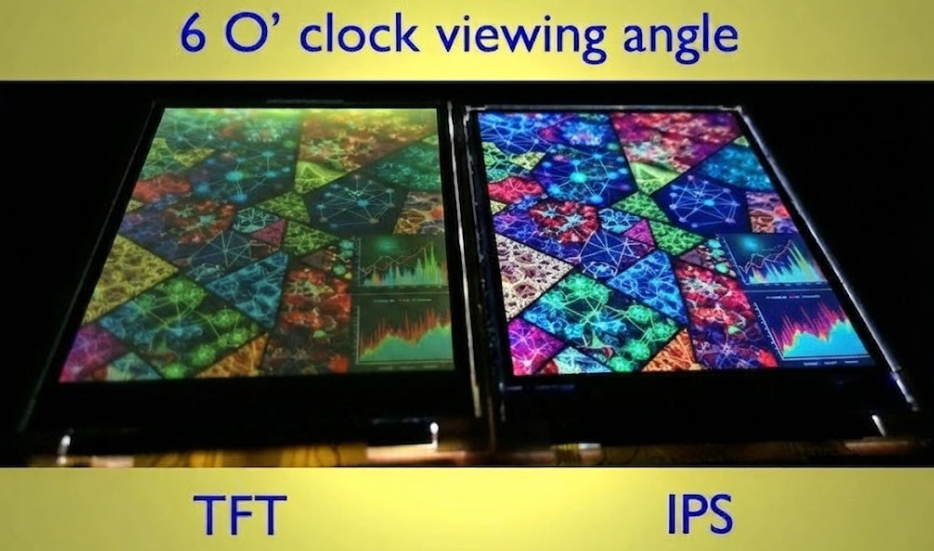
color consistency for IPS vs TFT displays
Brightness Testing: Test brightness levels prior to installation. The brightness of IPS panels should remain the same when viewed from different angles. If the replacement LCD dims at 45 degrees, then you have installed a substandard LCD.
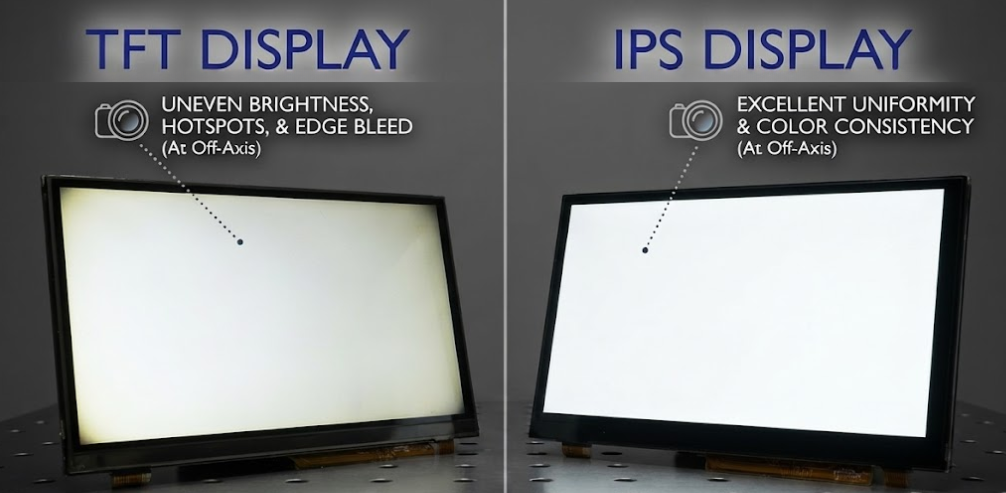
Brightness testing for IPS and TFT
Quality Inspection: Check the screen for dead pixels, color shift patterns, or brightness gradients prior to installation. IPS panels that have uneven brightness throughout the display are faulty.
Warranty Reduction: Lower-quality IPS panels result in higher return and warranty claims. On the other hand, quality TFT replacement for entry-level devices results in fewer complaints. This is because the expectations of the customers are set accordingly.
Customer Expectations: Inform customers on what they are purchasing. If the customer is using a TFT and wants to upgrade to a good-quality IPS. He will definitely feel the difference, and will appreciate the upgrade.
TFT, IPS, OLED, LTPS, and AMOLED Comparison
The more you know about display tech, the more you will be able to help your customers. Explore the comparative insights on TFT vs OLED vs IPS vs AMOLED vs LTPS
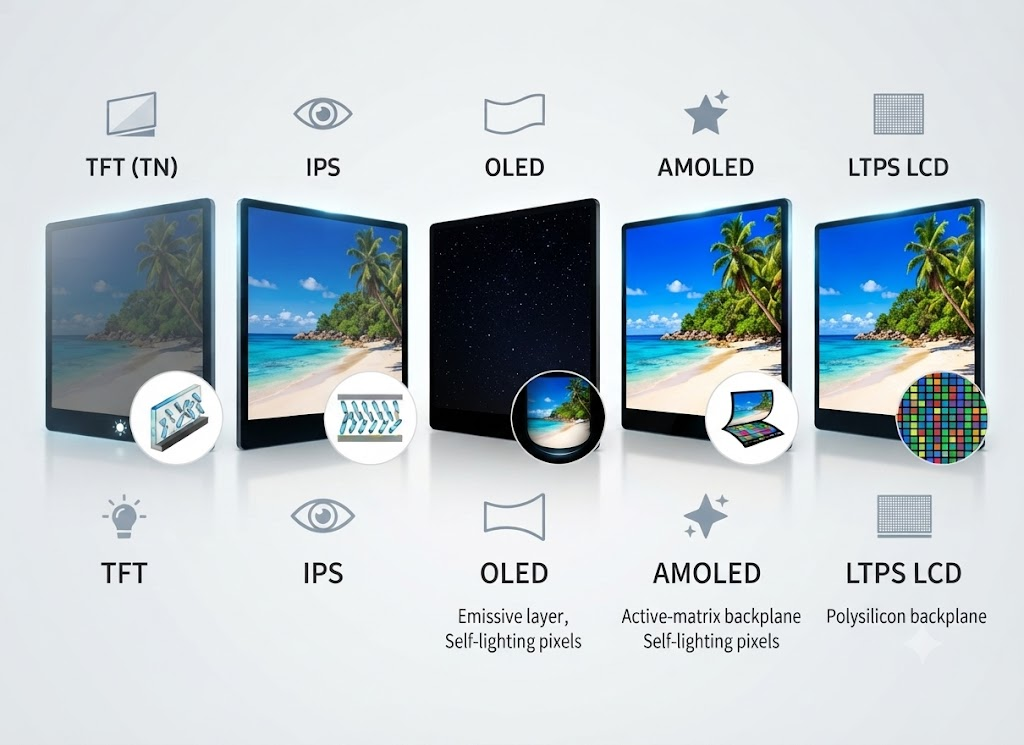
TFT, IPS, OLED, LTPS, and AMOLED Comparison
| Technology | Viewing Angle | Contrast Ratio | Response Time | Power Use | Typical Lifespan | Cost | Common Use |
| TFT (TN) | ~160° | ~600–1000:1 | 1–5ms | Lower (efficient backlight use) | 3–5 yrs | Lowest | Budget phones, POS, industrial panels |
| IPS | 178° | ~1000–1500:1 | 4–8ms (Fast IPS: 1–5ms) | 10–20% higher than TFT | 5–7 yrs | Moderate–High | Mid/flagship LCD phones, monitors, tablets |
| OLED | 178°+ | 100,000:1+ (true blacks) | <1ms | Efficient on dark content, less on bright/white | 3–5 yrs (organic degradation risk) | High | Premium phones, curved/flexible displays |
| AMOLED | 178°+ | 100,000:1+ | <1ms | Most efficient of the group | 3–5 yrs (burn-in risk) | Highest | Flagship phones, wearables, foldables |
| LTPS LCD | 178° (IPS-LTPS) | ~1000–1500:1 | 4–8ms | Slightly higher than standard TFT | 5–7 yrs | High | High-res smartphone/tablet LCDs |
Conclusion
The TFT vs IPS screens are not competing technologies, but a logical progression. IPS technology is an improvement on TFT’s tried and tested design. For most modern smartphones, it’s worth the extra price for better viewing angles and colour uniformity.
This distinction directly affects inventory decisions and customer satisfaction for phone repair shops, wholesalers, and LCD distributors. Knowing which devices need which technology allows you to order the right devices. This way, you can help customers replace the right technology, focusing on their needs.
The bottom line is that the mid-range and flagship phones require good-quality IPS replacement screens. The lower-end options are fine with good TFT displays. In the process of replacing LCDs, look for the most reliable display supplier and consider quality testing along with the lowest price point. Your warranty claims and reputation depend on it.
Ready to source premium replacement displays – Why choose SQLCD?
From high-end repair shops looking to integrate IPS screens into their flagship products to budget LCD manufacturers seeking dependable TFT screens. A reliable manufacturing partner is crucial.
Founded in 2009, SQLCD is a China-based factory. They supply repair shops, wholesalers, and refurbishers with inspected, color-accurate, and OEM display replacement solutions.
Low MOQs, full customization, and 6-12 month warranties ensure you have the correct mix of displays without over-committing your budget.
Whether you have 10 devices a month or 1,000, contact the SQLCD B2B team for free samples, custom specifications, or wholesale pricing.
Frequently Asked Questions – TFT vs IPS screen
Is IPS better than TFT?
For most consumer applications, IPS is superior when it comes to color accuracy, contrast, and viewing angles. But TFT is good when it comes to speed, power consumption, and cost.
Is IPS a type of TFT?
Yes, absolutely. IPS is an advanced version of TFT technology that optimizes liquid crystal alignment. Thin film transistors are present in all IPS panels.
Why do modern smartphones use IPS screens?
Display quality is important to consumers. IPS’s broad viewing angles and colour accuracy fulfill consumer expectations for photography, video viewing, and browsing on the Web.
Is TFT still good?
TFT is still reliable and is suitable for entry-level devices as well as for industrial applications. The definition of “good” is based on expectations and cost. For high-end screen users, it is not a good choice.
Which screen lasts longer?
The quality depends more on manufacturing and usage than technology. Good-quality IPS panels last longer than shoddy TFT displays. IPS offers a slight durability edge in harsh environments because of less thermal stress on liquid crystals.
Is IPS worth the extra cost?
Yes, for professional use, photography, or outside use. It costs about 20 to 30% more than the TFT displays. But at extra cost, it provides you with unmatched colors, no color shift, and viewing angles (178 degrees in all directions). If you’re just using the phone for basic needs, a good old TFT display serves the purpose.